
Reviewed · DUBROVNIK WALKING TOURS
Dubrovnik Old Town Walking Tour
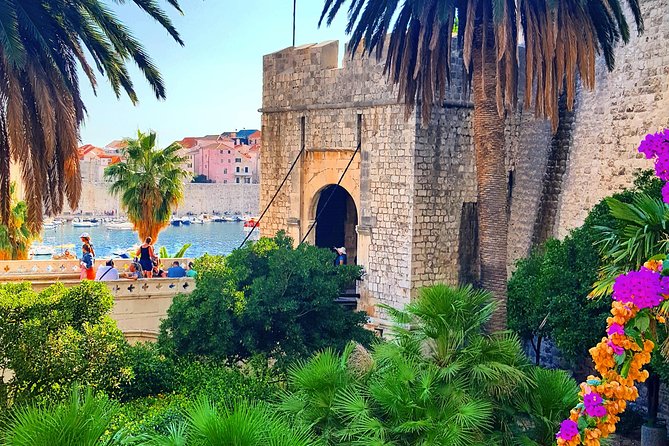
Dubrovnik’s Old Town makes more sense when someone helps you read its streets. This 90-minute walk starts at Pile Gate and links the city’s main sights with details you could easily pass by, from an aqueduct-fed fountain to a clock that shows time in two numeral systems.
I like that the route brings together major landmarks and small architectural details, and that a local guide can connect the city’s past with life there today. I also like the morning start: finish with time to revisit a sight or follow a restaurant tip.
One consideration: this is an overview, not an in-depth visit to every monument. The tour is listed as 90 minutes, though one itinerary description calls it two hours, so leave a little breathing room in your plans.
- Start at Pile Gate: Begin at a main entrance to the Old Town, then head into its narrow streets.
- See Onofrio’s Fountain: Learn how an aqueduct brought drinking water from a spring 12 km away.
- Walk the Stradun: Follow Dubrovnik’s limestone-covered main pedestrian street past landmark buildings.
- Get local context: Guides such as Elvis, Sara, Kat, Toni, Natalia and Tihomir have led past tours, though assignments can vary.
- Keep the group small: The tour has a maximum of 16 people, which can make it easier to ask questions.
- Plan for a first-day introduction: The route offers an overview, leaving you time afterward to choose what to explore more closely.
A quick introduction to the Old Town
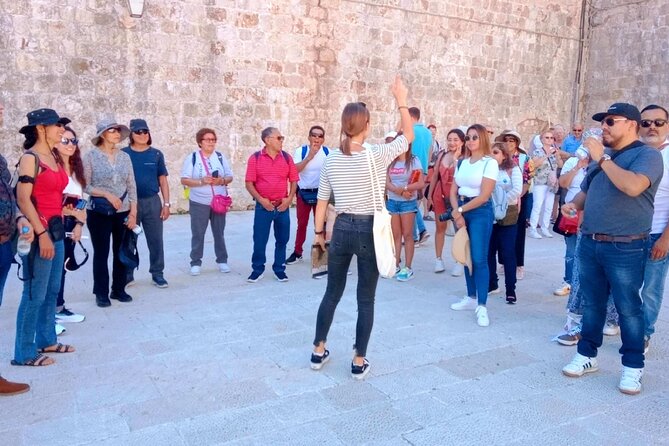
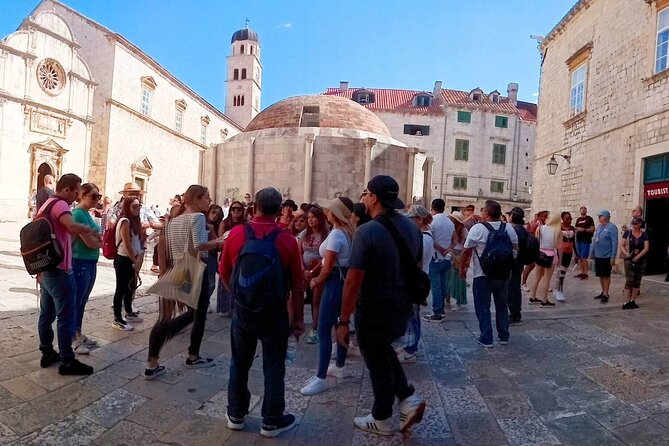
Dubrovnik’s historic center is compact enough to explore on foot, yet its streets and buildings carry more stories than a quick walk can reveal. A guide gives you a framework: where the Old Town begins, which landmarks matter, and how the city’s buildings fit together. That is the value of this tour. It helps you make sense of the place before you go back on your own.
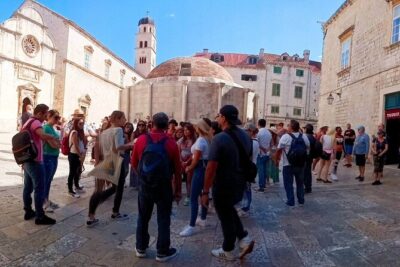
You meet at 10:30 am outside Elite Travel Walking Tours, at Brsalje ul. 1, near Pile Gate. From there, the route takes you through the Old Town’s narrow lanes and along the Stradun, with stops at several of its best-known sights. The guide speaks English, and the maximum group size is 16.
This is a walking overview rather than a wall walk or a series of long museum visits. You get a guided look at key landmarks and a local’s running commentary, then the tour returns to its meeting point. If you want a first orientation, that is a sensible use of an hour and a half.
Pile Gate sets the scene
Pile Gate is one of three entrances to the Old Town, and a practical place to start: it gives you a clear point of reference before you enter the historic center. Your guide begins the walk here and introduces Dubrovnik through stories and historical details, rather than simply pointing out buildings as you pass.
The early part of the route is especially useful if you have just arrived. The guide can give you a sense of how the Old Town is laid out and what to notice as you explore later. Several past guides, including Elvis, Sara or Sarah, Kat, Toni, Natalia and Tihomir, have been praised for combining facts with anecdotes and local perspective. Those names are examples, not a promise of who will lead your tour.
One practical plus: the route has been described as a good choice for people who would rather not tackle the many stairs found around Dubrovnik. It is still a walking tour, so expect to spend the time on your feet, but it is not a climb along the city walls.
More Old Town tours in Dubrovnik:
- Dubrovnik: Old Town Walking Tour
★ 4.8 · 5,174 reviews - Dubrovnik Discovery Old Town Walking Tour
★ 5.0 · 4,458 reviews - Dubrovnik Old Town History Walking Tour
★ 5.0 · 1,684 reviews
Onofrio’s Fountain and the water story
A few steps from Pile Gate, you reach Onofrio’s Fountain, a circular, multi-faucet drinking fountain. Its water came through an aqueduct from a spring about 12 km (7.5 miles) from town. That simple piece of infrastructure opens a window onto the practical work needed to supply a city with drinking water.
It is a good early stop because the fountain is more than a photo point. With a guide, you can connect its location and design to the way the Old Town functioned. The route does not list a separate entrance fee for this stop, and the fountain sits on the walking route.
Expect the guide to keep the group moving between nearby sights. That is part of the format: the sites are close together, and the aim is to give you a connected overview rather than linger for a long time at each one. If you want a detailed look at every feature, make a note of what catches your eye and return after the tour.
The Franciscan Monastery’s quieter corner
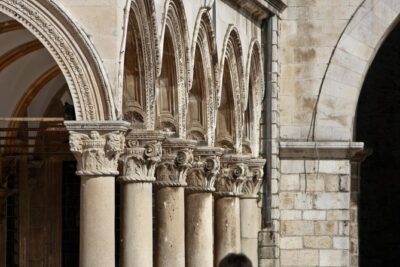
The Franciscan Monastery is another short walk from the fountain. The complex includes a 14th-century Gothic cloister and a restored sculpture of the Pietà. It is also home to one of Europe’s oldest still-functioning pharmacies, a striking detail in a tour that otherwise moves through streets and civic landmarks.
This stop gives the route a change of pace. After the open space around the fountain and the movement of the main street, the cloister offers a chance to focus on the monastery’s architecture and art. The guide can point out features you might not notice while simply passing through.
The tour description includes the monastery among its stops, but it does not spell out how much time is spent inside or whether any particular interior access is guaranteed. Treat it as a guided visit to the landmark, not a promise of a long, self-paced exploration. If the pharmacy or artwork is a priority, check what is open on the day and allow time to return independently.
Stradun, Sponza Palace and the city’s central sights
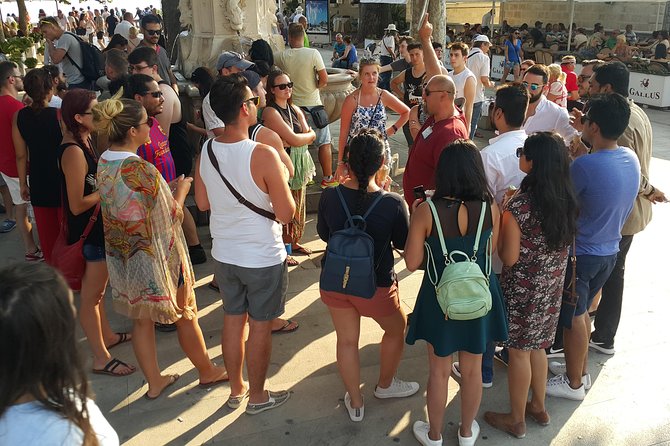
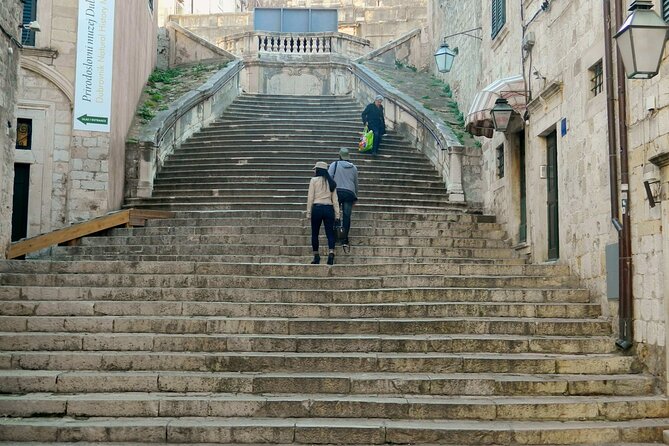
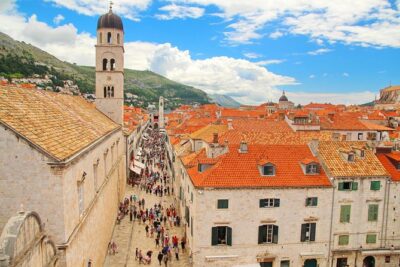
The Stradun is Dubrovnik’s limestone-covered main pedestrian street. Walking along it helps you understand the Old Town’s central axis: instead of threading through side lanes, you get a broad view of the historic core and the major landmarks gathered around its main square.
Sponza Palace is the Renaissance-era highlight on the route. It now houses the State Archives, so its role today is tied to preserving records as well as its architectural past. The palace is one of several sights where the guide’s context can help you read a building as more than a handsome façade.
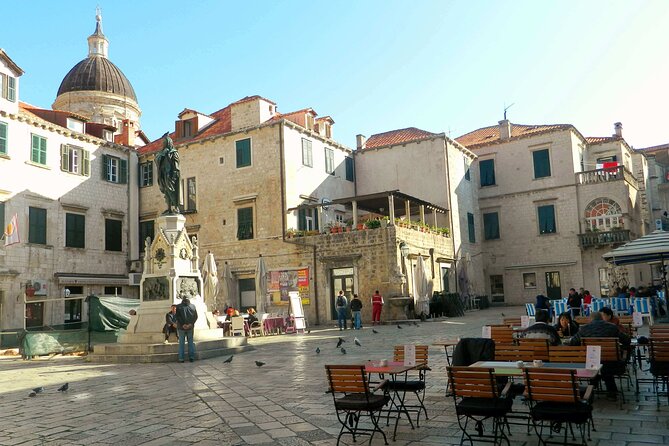
Nearby, you’ll see Orlando’s Column, the City Bell Tower, Rector’s Palace and the Church of St. Blaise, Dubrovnik’s patron saint. The bell tower has a quirky detail: its clock shows time in Arabic and Latin numerals and changes only every five minutes. It’s exactly the kind of small fact that makes a quick tour more memorable than a list of names.
Rector’s Palace appears on the route, but there is an important distinction between seeing a landmark and visiting its museum. Dubrovnik’s Museums Multipass includes the Cultural-History Museum in Rector’s Palace, along with several other museums and collections. The walking tour itself includes a local guide; the pass is a separate option, not listed as part of the tour price. If you want to go inside museums, plan for that separately.
More walking tours in Dubrovnik:
- Dubrovnik: Game of Thrones Walking Tour
★ 5.0 · 1,732 reviews - Dubrovnik: City Walls Early Morning or Sunset Walking Tour
★ 4.8 · 1,523 reviews - Dubrovnik: Ancient City Walls & Wars Walking Tour
★ 5.0 · 1,270 reviews - Dubrovnik: Game of Thrones Walking Tour
★ 4.9 · 981 reviews
The Cathedral of the Assumption
The route crosses the main square to the Baroque Cathedral of the Assumption. The present cathedral dates to the 18th century, after an earthquake destroyed the earlier building. That gives the stop a clear story of loss and rebuilding, and a final landmark to round out the walk.
The Cathedral Treasury is also named among the sights, but the tour details do not specify how much time is spent there or whether treasury admission is included. The listed inclusion is a local guide, so ask before booking if access to a particular interior is essential to you.
As with the other stops, the benefit is the guide’s explanation and the overall sequence. You have seen the fountain, monastery, main street, civic buildings and cathedral in one connected route. Afterward, you can decide which places deserve a longer visit.
What the guide adds

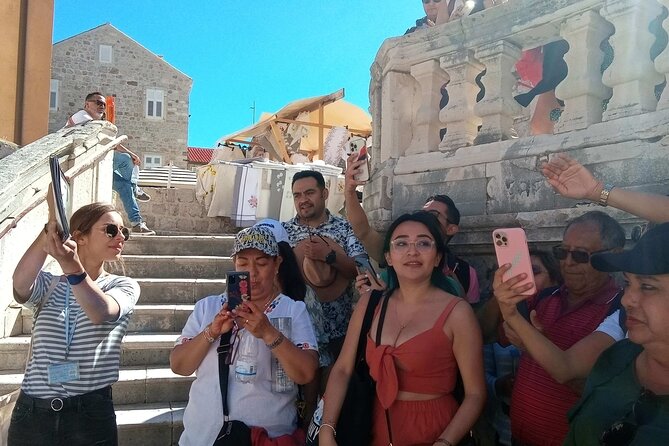
The guide is the main reason to book this experience rather than simply follow a map. The strongest descriptions of past tours point to guides who explain both the city’s history and its present-day customs, answer questions, and share details that are easy to miss. Elvis is a recurring name in the feedback, with Sara or Sarah, Kat, Toni, Natalia and Tihomir also mentioned. You cannot request or count on a particular guide based on the information here.
A good guide can also make the pace more comfortable. One past tour was described as gentle, and another guide was praised for finding shady places to stop and speak. That can matter on a sunny morning, though shade is not something a tour can guarantee. Clear English and the ability to hear the guide matter too: one person found a guide difficult to hear and left early. If you have trouble hearing in a group, stand close to the guide and ask questions when needed.
Some guides have also shared restaurant suggestions and local tips. That is especially useful at the start of a stay, when you are still deciding where to spend your time. You get more than a short history lesson: you can leave with ideas for your independent exploring.
Is $31.46 a fair price?
At $31.46 per person, this is a modest-cost way to get an introduction to Dubrovnik from a local guide. The price covers the guided walk, not hotel pickup, food or drinks. It is strongest value if you use the tour to orient yourself early in your stay and then return to the sights that interest you most.
The group cap of 16 helps keep the walk from becoming a large procession. Smaller groups can make it easier to hear, ask a question or talk with the guide, though the actual group may be smaller or close to the limit. Past tours have sometimes had very few people, and one became a private walk when bookings were low. That is possible, not guaranteed.
The main trade-off is depth. Ninety minutes is enough to see a cluster of major sights and hear a helpful overview, but not enough to explore each one fully. If you already know Dubrovnik well or want extended time inside museums, you may prefer to explore independently. If you are new to the city, the context can be worth more than another hour of wandering without a plan.
Timing, meeting point and booking notes
The tour starts at 10:30 am at Elite Travel Walking Tours, Brsalje ul. 1, 20000 Dubrovnik, near Pile Gate. It ends back at the same meeting point. There is no hotel pickup or drop-off, so arrange your own way to the start.
The tour is offered in English and uses a mobile ticket. It is booked, on average, 21 days in advance, which is a useful cue to plan ahead if your dates are fixed. Confirmation is received at booking. The published duration is approximately 90 minutes, although one route description refers to a two-hour walk; leave extra time rather than scheduling a tight connection immediately afterward.
Most people can participate, and the tour requires good weather and a minimum number of participants. If poor weather or low bookings lead to cancellation, you are offered another date or a full refund. You can cancel for a full refund up to 24 hours before the start; changes or cancellations inside that window are not accepted.
Should you book this Dubrovnik walk?
Book it if you want a compact first look at the Old Town, appreciate a local guide’s stories, and would like to decide afterward which places deserve more of your time. The route covers a useful range, from the water system at Onofrio’s Fountain to the cathedral and the central civic landmarks, without taking up most of your day.
Skip it if you want a long, detailed museum visit or a walk along the city walls. This tour is about orientation and context, not exhaustive access. For many first-time visitors, that is the point: take the morning walk, listen for the details that interest you, then use the rest of the day to explore at your own pace.
FAQ
How long is the Dubrovnik Old Town Walking Tour?
The advertised duration is approximately 1 hour 30 minutes. One description calls it a two-hour tour, so it is wise to allow some extra time.
Where does the tour start and end?
It starts at Elite Travel Walking Tours, Brsalje ul. 1, near Pile Gate. The activity ends back at the meeting point.
What time does the tour begin?
The stated start time is 10:30 am.
What language is the tour offered in?
The tour is offered in English.
What is included in the price?
A local guide is included. Hotel pickup and drop-off, food and drinks are not included unless specified.
How many people can join the tour?
The maximum group size is 16 people.
Does the tour include admission to museums?
The listed inclusion is a local guide, and the tour does not state that museum admission is included. A Museums Multipass is available separately and covers several Dubrovnik museums, including the Cultural-History Museum in Rector’s Palace.
What is the cancellation policy?
You can cancel at least 24 hours before the start for a full refund. Cancellations or changes made less than 24 hours before the start are not accepted.
Recently added in Dubrovnik
- Private tours to Elaphite Islands by UFO BOAT★ 5.0 · 6 reviews
- TOP OFFER: Dubrovnik to Split via Ston, Počitelj, Mostar, Kravica★ 5.0 · 15 reviews
- Peljesac Wine & Ston Oysters PRIVATE HALF DAY SHORE TOUR★ 5.0 · 10 reviews
- Dubrovnik Old City Walls Private Tour★ 5.0 · 12 reviews
- Ston Tour: City Walls, Saltworks, Wine & Adriatic Seafood★ 5.0 · 3 reviews
- Pelješac Wine, Beach and Lunch – Relaxing Tour from Dubrovnik★ 5.0 · 15 reviews
- Private Full Day Peljesac Wine Tasting Tour from Dubrovnik★ 5.0 · 35 reviews
- Visit magical Mljet Island with private speedboat★ 5.0 · 7 reviews
Dubrovnik Walking Tours, compared.


City Walls Early Morning or Sunset Walking Tour
Read our review →
Dubrovnik Cable Car Ride, Old Town Walking Tour plus City Walls
Read our review →
Dubrovnik Food and Drink Walking Tour with a Local Guide
Read our review →Browse the lists this tour appears in